
I have always been intrigued by the unique show cars that Pontiac created each model year for its new car show displays. Many boasted customized features aligned with a central theme and the vehicle name followed suit. Some recognizable Pontiac show cars include the ‘64 GTO-based Flamme’ and ’67 Firebird-based Skydiver. If you’ve read my past blogs, you know of Cielo Del Sol, La Vinta, and Valencia. You might also know that Pontiac publicly sold many of those show cars upon the show season’s cessation.
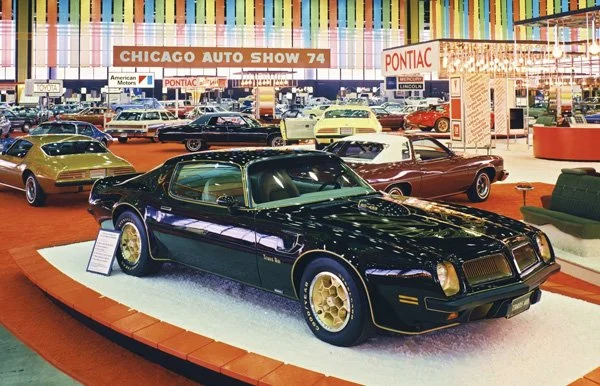
The black-and-gold Trans Am was billed as the “The Ultimate Firebird” by Pontiac upon its public debut at the 1974 Chicago Auto Show. Prior to this example, I was unaware of any other early Trans Am show cars.
The Firebird Trans Am was Pontiac’s newest entry in the performance car market going into 1970. By 1974, the Division campaigned a uniquely painted example on the show circuit. John Schinella and Bill Davis created a black-and-gold ’73 Trans Am for Bill Mitchell. It was then updated to ‘74 styling and became renowned when it appeared in Pontiac’s display at the 1974 Chicago Auto Show. The car garnered so much consumer interest that Pontiac released its Y82 Special Edition appearance package in 1976 as a result. While other Trans Am show cars followed, I was completely unaware of any that came before it—until January 2014.
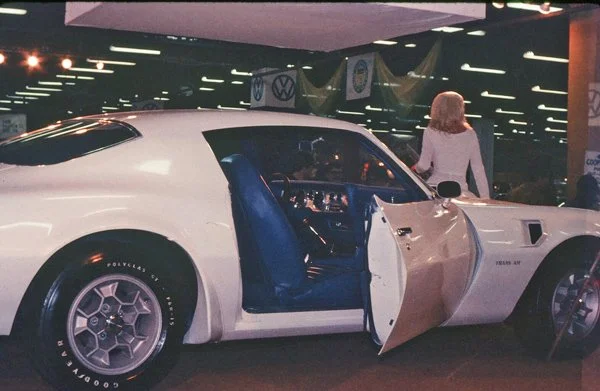
I first saw this image of the customized ‘71 Trans Am on eBay in 2014. The peal white exterior and body-colored Shaker suggested something much different than the typical livery the Trans Am was available in that model year.
One day while casually perusing eBay, I happen across a listing containing images of a customized ‘70-73 Trans Am on display at an auto show. I recall that the description offered no clues, but I immediately noticed its Honeycomb wheels with unadorned center caps, high back bucket seats, and “455 H.O.” Shaker decals—all new features for 1971. The white exterior seemed metallic or pearlescent, and the blue interior was an unusual shade. The Trans Am’s most interesting feature, however, was a Firebird logo hood applique similar to that Pontiac offered in 1973 in place of the single racing stripe over the length of the car.
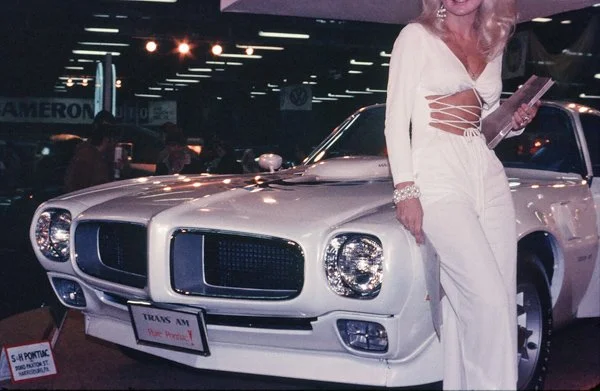
A second image from the eBay auction reveals what appears to be a unique hood bird in place of the Trans Am’s single racing stripe. I was surprised by the car’s existence then, and have been searching for more information ever since. A small “S&H Pontiac” placard at lower left suggest some type of new car event.
As I took in the minute details of the low-resolution images in the auction listing, my first thought was that a private owner had customized his or her ’71 Trans Am. The display seemed far too elaborate for that and the hired talent handing out Pontiac brochures aligned with a new car event. Then I saw the “S & H Pontiac” signage—a Pontiac dealership located in Harrisburg, Pennsylvania—which solidified the new car show theory. I wondered if this ’71 Trans Am was an S & H Pontiac exclusive? Or could it be a factory show car?
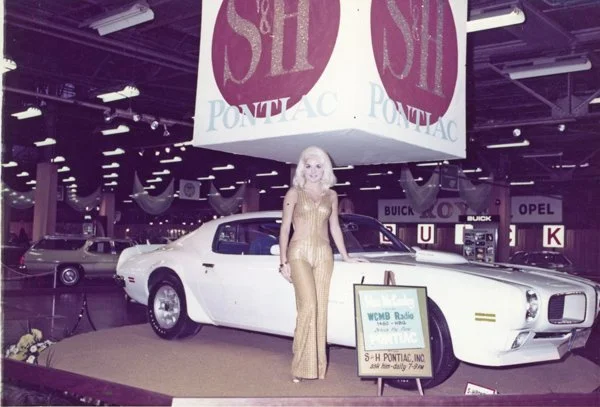
Hobbyist Parrish Falk purchased the original slides from the eBay auction. He was also able to locate several more photographs of the customized Trans Am. This one confirms that it was the centerpiece of the S & H Pontiac display at 1971 Harrisburg Auto Show.
A web search revealed that the 1971 Harrisburg Auto Show began January 26 that year. I surmised the customized Trans Am was photographed there but remained perplexed by its existence. And what about that hood bird? Bill Porter’s initial attempt for 1970 was verbally thwarted by Bill Mitchell. It wasn’t until January 1972 that John Schinella and Bill Davis proposed the hood bird concept to Pontiac in the Design Dome—a full year after this ‘71 Trans Am was displayed in Harrisburg. And, yes, there was Bill Mitchell’s pearl white ’72 Trans Am with hood bird, but even then, this ‘71 Trans Am predated Mitchell’s by an entire model year. The whole situation made no sense to me.
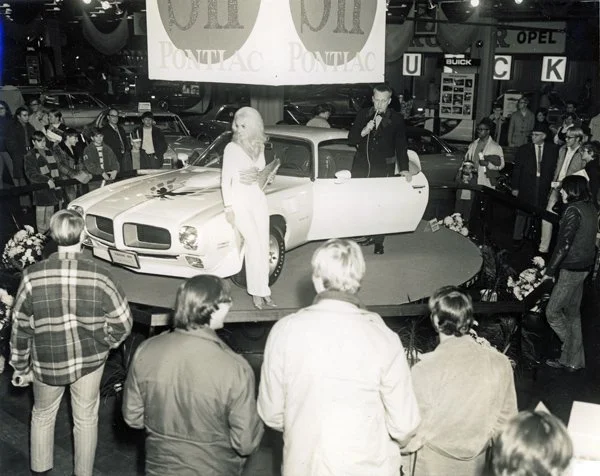
This photo that Parrish Falk shared with me provides a much better look at the enlarged Firebird logo on the Trans Am’s hood. The color photographs from that event suggest that it’s comprised of a black body with blue wing feathers, which corresponds with the vehicles’ overall color theme. Note the applique’s similarity to the production hood bird introduced in 1973.
I tried winning the eBay auction but was outbid. A few days later I received an unexpected email from fellow Pontiac hobbyist Parrish Falk. He had won the eBay auction and offered to share electronic copies of the images with me. He added that the slide holders contained a processing date of February 1971, which confirmed the Harrisburg Auto Show theory. When I received the high-resolution images Parrish so generously sent, it allowed me to better see the car’s features. The exterior was clearly pearl white, its custom interior was a unique shade of royal blue, and it was equipped with a 4-speed manual transmission. I could also see a blue and black hood bird similar to the 1973 design.
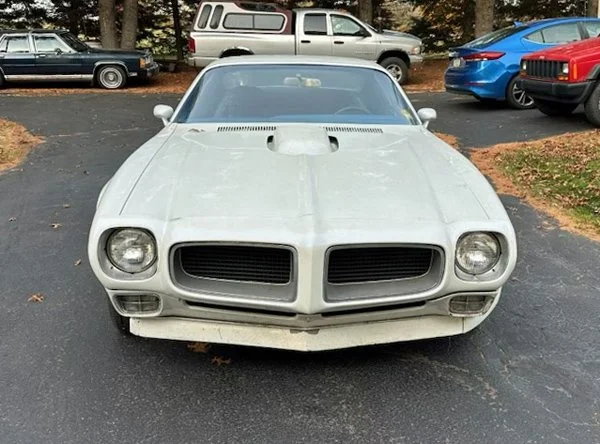
Rob Stark purchased this ’71 Trans Am in October 2024 from his girlfriend, Jackie’s family. Her father, George Waschko purchased the car from Scutti Pontiac in Rochester, New York. At first, Rob thought that it was just a typical ‘71 Trans Am. Little did he know, he had something very special.
Captivated by the existence of this customized ‘71 Trans Am, and how attractive it looked in the images, I yearned to know more about it. In the months and years that followed, I reached out to my cache of Pontiac insiders including Bill Porter, John Schinella, Bill Davis, and Herb Adams. Unfortunately, no one had any recollection of the car. Typically, Pontiac-produced show cars were displayed at large scale events in New York, Detroit, and/or Chicago, and press photos and/or releases from Pontiac Public Relations accompanied them. I tried my contacts at GM Media Archives, but no images or information could be found on this car. It seemed every possibility I tried in the months and years that followed resulted in a dead end.
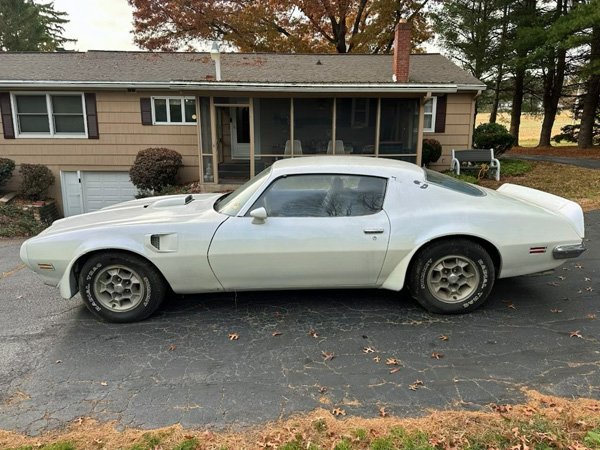
Rob’s friend, Tony Durso sent me an email sharing the Trans Am’s details. He followed with an email containing many of the photos in this story. I’m excited to report that Rob’s car is the car displayed at the 1971 Harrisburg Auto Show! 55 years later, it’s finally been identified.
Then, on November 30, 2025, I received an email through PontiacV8.com from hobbyist, Tony Durso. His friend, Rob Stark—of Drums, Pennsylvania—had recently purchased a ’71 Trans Am from his girlfriend’s family. Her late father purchased the car new and it largely sat the past few decades. Rob planned to restore the car back to its original configuration but was confused by its accompanying paperwork. Tony asked if I could help he and Rob understand what they truly had.
While Design Staff produced a number of factory show cars, Pontiac Motor Division had the ability to modify vehicles in its Engineering garage—that included bodywork and exterior repaints. Documentation reveals that this ’71 Trans Am was one of many examples customized by Pontiac over the years.
According to the factory invoice obtained from PHS Automotive Services, the Trans Am was delivered to Pontiac Engineering. “Is it possible this was an engineering car?” Tony wrote in his email to me. “The ship date was September 10, 1970. According to the factory invoice and [cowl-mounted] data tag, it should be Cameo White with Black Custom interior. The car is currently pearl white with blue interior. It was most likely customized back in the day, but the family claims the car was like this since new. We will probably never know its real history.”
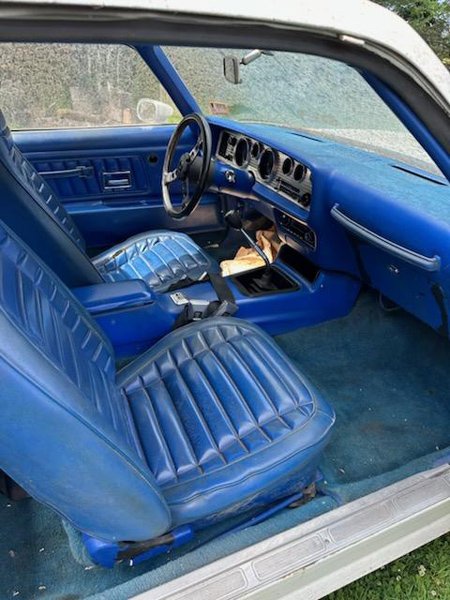
As soon as I saw this image of the Trans Am’s blue interior, I was convinced that it had to be the customized model in the images from the 1971 Harrisburg Auto Show.
The instant I read “delivered to Pontiac Engineering,” “pearl white with blue interior,” and “like this since new,” my mind started spinning. Could this ’71 Trans Am be the car at the Harrisburg Auto Show that I’ve been searching to learn more about for the past decade? I replied asking Tony if there were any photos he could share with me. As soon as his reply hit my inbox, the first image I saw was of that unique shade of blue interior. I jumped out of my seat!
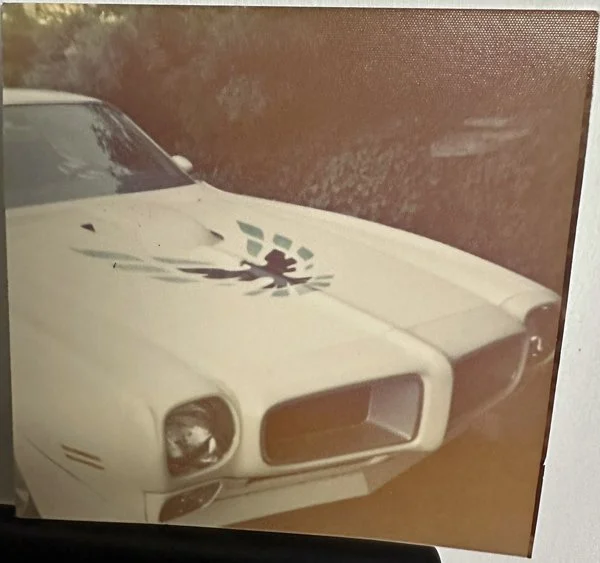
This vintage photograph from the Waschko family archive absolutely confirms that George’s Trans Am was the customized show car at the 1971 Harrisburg Auto Show. Who at Pontiac could have conjured up such a feature? Retired GM designer, Jeff Denison shares that Bill Porter’s hood bird proposal was laid out on two 1970 Trans Ams. One car stayed at Design Staff while the other car was sent to Pontiac for review. When Bill Michell saw Porter’s layout on the Trans Am at Design Staff, he adamantly ordered that it be immediately removed . It’s possible that the car Porter sent to Pontiac inspired this example.
It had to be the ’71 Trans Am from the Harrisburg Auto Show—the timeline and locales aligned. I sorted through the other photos Tony sent and found Rob’s Trans Am equipped exactly like the show car. It was well used and had clearly sat for some time, but it looked original and complete—almost as if it had been lost in time. Its pearl white exterior seemed correct, but the unique hood bird and “Trans Am” lettering was noticeably absent. I wondered if Pontiac had removed the applique before releasing the car for public sale or this simply was someone’s coincidental attempt. Then, amidst the images of its paperwork were a vintage photograph the family had of the car. There was that hood bird! There was no mistaking—this was the car!
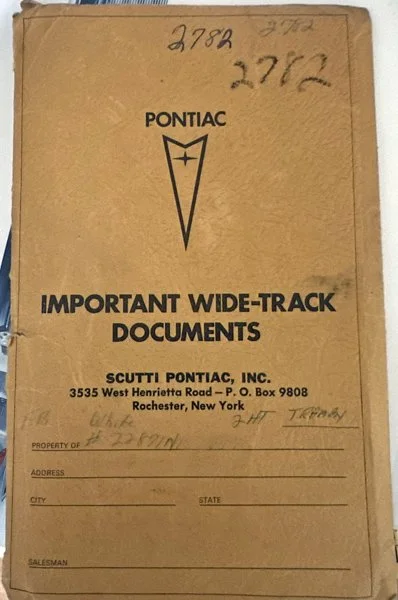
The customized Trans Am show car was at Scutti Pontiac in Rochester, New York at some point during the summer of 1971, and that’s where George saw it. It’s uncertain if the Pontiac Zone had the car positioned in Rochester for an area event or it was placed in Zone inventory and Scutti won its purchase with highest bid. Either way, Scutti Pontiac was its selling dealer.
Tony connected me with Rob and I arranged a phone call with him. Rob shared that George Waschko—his girlfriend, Jackie’s father—lived in Conyngham, Pennsylvania. While attending pharmacy school in Boston during the early 1970s, George worked a couple of summers at a pharmaceutical company in Rochester, New York. It seems George saw the Trans Am at Scutti Pontiac while in Rochester. He was told that it was a special Pontiac show car and purchased it in August 1971.
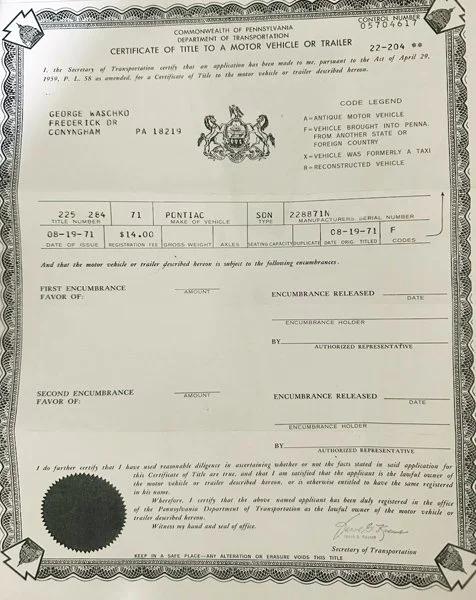
A copy of the original Pennsylvania title in George’s name contains an issuance date of August 19, 1971.
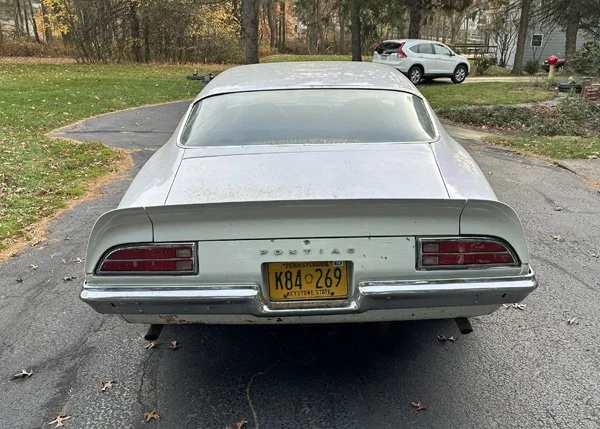
George drove his customized Trans Am daily for the next few years putting more than 60,000 miles on it in that time. Vintage receipts and letters from Pontiac dated 1975 suggest that the 455 H.O. developed a mechanical issue that led to piston replacement. It appears George last registered the car in 1977 and it sat for several years. Sometime during the 1990s, he elected to have its pearl white exterior repainted in a similar, if not identical hue, which explains the now missing hood bird. It’s possible George planned to recreate the unique feature at some point after the repaint. The Trans Am sat several more years, ultimately entering a level of disrepair.
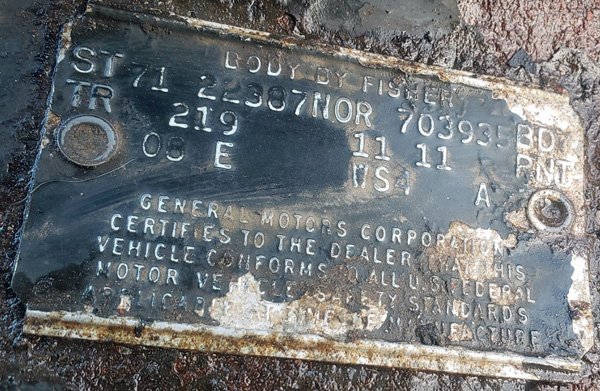
The cowl-mounted data tag reveals that the Trans Am was produced at the Norwood, Ohio assembly plant during week 08E (last week of August) 1970. It was originally finished in Cameo White with Black Custom interior. It was modified by Pontiac for show duty.
Sadly, George passed away in October 2020 halting his future plans for the Trans Am. The Waschko family had only vague details about the car. Based on what George told them, they knew it was significant, but nothing specific. Not long after Rob began dating Jackie, George’s family sold their house, which meant moving the non-running Trans Am. Rob offered his home garage as temporary storage and the car was trailered there. Then, when the family began contemplating selling the car, Rob quickly purchased it in October 2024. After all, what Pontiac enthusiast wouldn’t want a ’71 Trans Am backed by a 4-speed manual?
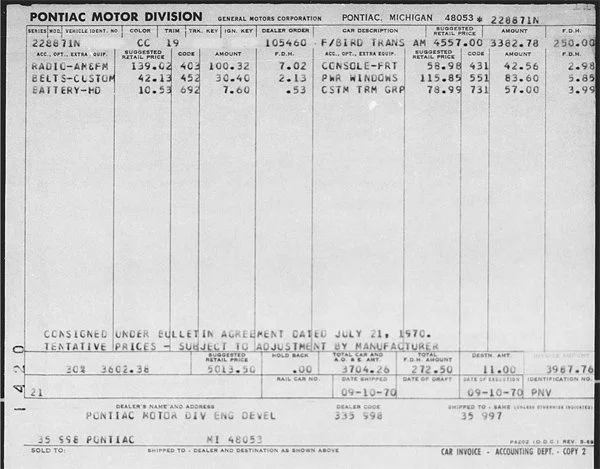
The Trans Am’s invoice reveals that it was originally shipped to Pontiac Engineering on September 10, 1970, which coincides with its 08E build date. PHS was able to locate two subsequent invoices for the car. A December 11, 1970-dated invoice shows Pontiac Zone assignment and includes a $33 increase in base price. A March 10, 1971-dated invoice also shows Zone status and an additional base price increase of $5. Certainly, an invoice was generated when billed to Scutti Pontiac, but it seems Pontiac didn’t retain that record.
Rob was excited with his new purchase, but he wasn’t able to connect the Trans Am’s documentation with the significance George conveyed to his family. Now, with Tony Durso’s help Rob can truly appreciate his Trans Am for what it is—a factory show car! And it’s one we can say with absolute certainty that Pontiac offered it for public sale through Scutti Pontiac after its tenure on show duty.
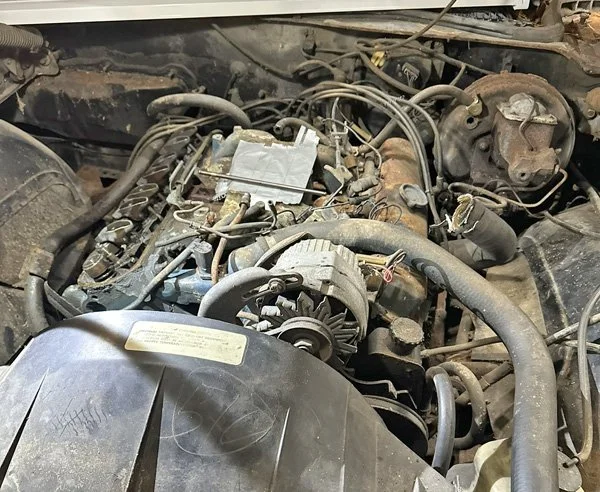
The Trans Am’s numbers matching 455 H.O. and M22 4-speed manual transmission remain in the car. Rob recently was able to get it running.
I feel fortunate to have played a role in identifying this customized Trans Am as that displayed at the 1971 Harrisburg Auto Show. I am also relieved to have solved the mystery of the pearl white ’71 Trans Am that’s evaded me for more than a decade. Thank you to Tony Durso and Rob Stark for letting me part of it.
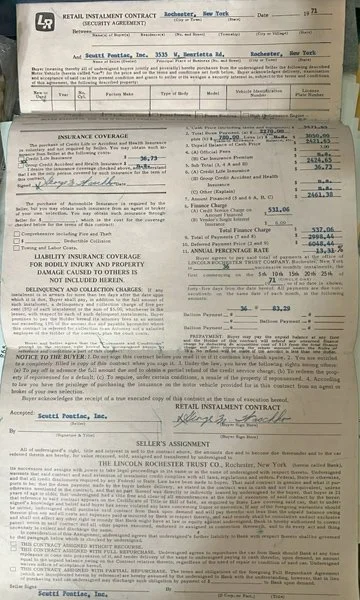
It seems George’s original plan was to finance the Trans Am through Scutti Pontiac. However, this unexecuted document suggests he either financed the purchase through a different lender or paid for it in full. Note the selling price of $5,471. Considering that, as built, the Trans Am had an MSRP of $5,013, Scutti must have charged a premium for this one-off show car.
Now, just when you think I can close the case on this car, I have new questions to ponder! For instance, what other new car shows during the 1971 model year was this pearl white Trans Am displayed at? And how did the car end up at Scutti Pontiac?
Maybe seeing these photos of the customized ’71 Trans Am will invoke recollections from your past. If so, I’d love to hear them!