
Recently I was discussing with a fellow hobbyist Pontiac’s revered WS6 suspension package developed for the 1978 Trans Am. Comprised most notably of specific springs and shock absorbers, a larger-diameter rear sway bar, higher-durometer sway bar bushings, and 15 x 8-inch cast aluminum (Snowflake) wheels, it transformed the Trans Am into a world class road car that handled and rode superbly. WS6 availability expanded to the Formula for 1979, and it remained a desirable option through 1981.
When I think of second-gen Trans Ams equipped with WS6, my mind immediately goes to the ‘79 Trans Am that my father, Jim Rotella purchased in spring 1984. He drove that car daily until spring 1991 when a turbocharged Buick Regal took its place. My first long-term experience with the WS6 package, I spent thousands of miles in that Trans Am going to and from school, sporting events, and transportation in general.
While I think of the ’79 Trans Am often, my recent WS6 discussion got me thinking that neither my dad and I really knew its true origin—and that piqued my curiosity. I knew he kept its original window sticker, so I asked him to dig it out for me to see. Also, in the envelope was the car’s original build sheet. I’d forgotten he even had that. I then decided to purchase the car’s original factory-to-dealer invoice from PHS Automotive Services to round out its original documentation. That’s when I learned of the car’s unique origin! But before I get to that, here’s how it came to be a Pontiac in our family.
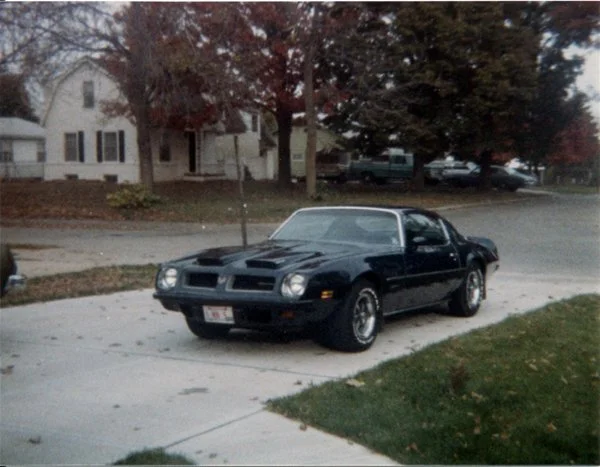
During the early 1980s, my dad was driving this ‘74 Formula 350 on a daily basis. By 1984, it had more than 100,000 miles on its odometer and began needing more serious repairs. It was time for him to look for something else to drive.
You may recall past blogs on my dad’s Chesterfield Brown ‘78 Trans Am. He owned that car until 1988—driving it sparingly during that time—when he sold it to purchase the ’72 Trans Am. His daily driver in the early-1980s was an Admiralty Blue ’74 Formula 350. “The Formula was a nice car,” he recalls of it, “but by 1984 it was 10 years old and had about 100,000 miles on its odometer. The Nebraska winters had taken their toll—it started needing larger (and costlier) repairs. It was time for me to get something different.”
That spring, my dad started looking through the classified ads of our local newspaper—the Omaha World Herald. “I really didn’t have my mind set on anything in particular but did want something sporty—and preferably a Pontiac,” he says. “You were young and your mother and I were expecting your sister, Gina. Your mom had the ’73 Grand Prix SJ for family use, so I figured I’d look for another Formula or a Trans Am but would have taken a Grand Prix or even a Z28.”
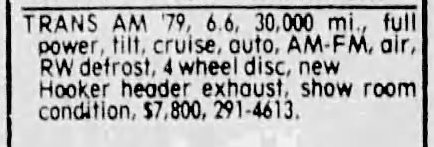
This ad for the ‘79 Trans Am appeared in the Omaha World Herald on Sunday, April 22, 1984 It immediately caught my dad’s eye.
In April 1984, my dad saw an ad for a second-gen Firebird that caught his eye. “It was a fully-loaded ‘79 Trans Am with 30,000 miles and in showroom condition,” he says. “I loved those cars and a low-mile example in like-new shape seemed perfect for me. The ad said it had a 6.6-liter engine with automatic transmission, which I knew meant was the 403 Olds. It said nothing of the color.”
When Pontiac introduced its 1979 Firebird, some criticized the styling refresh. “I thought John Schinella did a great job with it,” my dad says. “I saw the sleek Silverbird race car in new car magazines back then and thought the 1979 Firebird looked a lot like it. I also really liked the Formula and Trans Am’s blacked-out taillights. I remember (Omaha restauranter) Ross Lorello Jr. bought a new Turbo Trans Am in 1980. It was dark blue with tan interior and had gold decals. I thought that car looked great.”
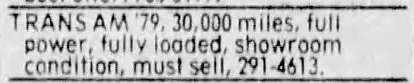
A week later, on April 29, 1984 the seller posted in ad. My dad purchased the car a day or two later.
My dad called and learned the seller was an airman in the Air Force stationed at Offutt AFB in Bellevue, Nebraska. “He was from being transferred and had to sell the Trans Am,” my dad recollects. “My first question was, ‘What color is it?’ When he said, ‘dark blue with off-white interior,’ I was really interested because I loved that color combination. He told me that it was in perfect shape, loaded with options, and had WS6 suspension. He also installed Hooker headers with true dual exhaust.”
As an excellent candidate for a daily driver, my dad was excited to see the Trans Am in person. “It had all the options I really could have asked for,” he explains. “Sure, I would have preferred the T/A 6.6, but it was only available with the 4-speed manual that year and I felt the automatic was better suited for everyday driving. I remember being happy hearing that it was not equipped with t-tops. They were known to leak, and I didn’t want any issues with that.”
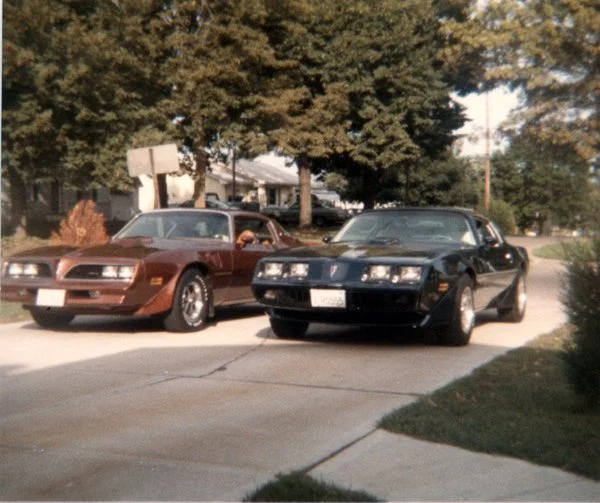
The Chesterfield Brown ‘78 Trans Am was purchased new by my dad in February 1978. It only had a few thousand miles on it in 1984 when my dad bought the Nocturne Blue ‘79 Trans Am to drive daily.
My dad went to see the car. “The seller was living in base housing near Offutt AFB,” he recollects. “When I arrived, the Trans Am was parked beneath a car port. It looked so nice sitting there. I was very impressed—it really was in showroom condition. The original tires were still on it. The seller bought it used in South Dakota. He said it hadn’t ever been driven in the snow and that seemed to be true. He had the original window sticker for it. In fact, it was so loaded with options that it carried over onto a second page.”
On the test drive around the area, my dad remembers, “It drove like a new car. It definitely rode and handled better than my ’78 Trans Am because of the WS6 suspension package. I wasn’t expecting the difference to be that noticeable, but it was. The gray 15 x 8-inch Snowflake wheels with polished edges looked great. The Hooker headers with true dual exhausts gave the exhaust note a very deep rumble.”
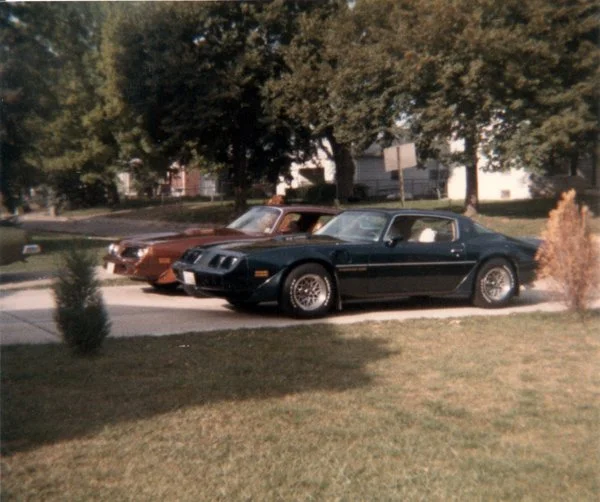
The ‘79 Trans Am was the first second-gen Firebird that my dad owned that was equipped with WS6 suspension. The Nocturne Blue exterior, oyster and light blue interior, and gold decals proved a stunning combination.
The 403 Olds was rated at 185 hp and my dad was familiar with the 220 hp T/A 6.6 in his ’78 Trans Am. Of the performance comparison, my dad says, “You have to remember, it was 1984 and there were hardly any new performance cars at the time that could compare to either of them. The ‘79 Trans Am wasn’t as fast as my ’78, but I also didn’t expect it to be. The ’79 Trans Am had an automatic transmission and 2.73:1 rear axle ratio and the ’78 Trans Am had a 4-speed manual with 3.42:1 gears. The 403 Olds was peppy enough for me though. It would even occasionally chirp its rear tires on the 1-2 upshift under heavy throttle.”
My dad was ready to purchase the ’79 Trans Am, but before doing so, he wanted my grandfather’s opinion of it. “I told the seller I’d be back with my dad for a second look,” he recalls. “We went back a day or two later and upon seeing it, your grandpa said, ‘It’s like a new car—don’t hesitate on buying it.’ I figured that’s exactly what he’d say.” My dad and the seller agreed on the price—somewhere around $7,200 as my dad recalls—and he returned the next day with payment.
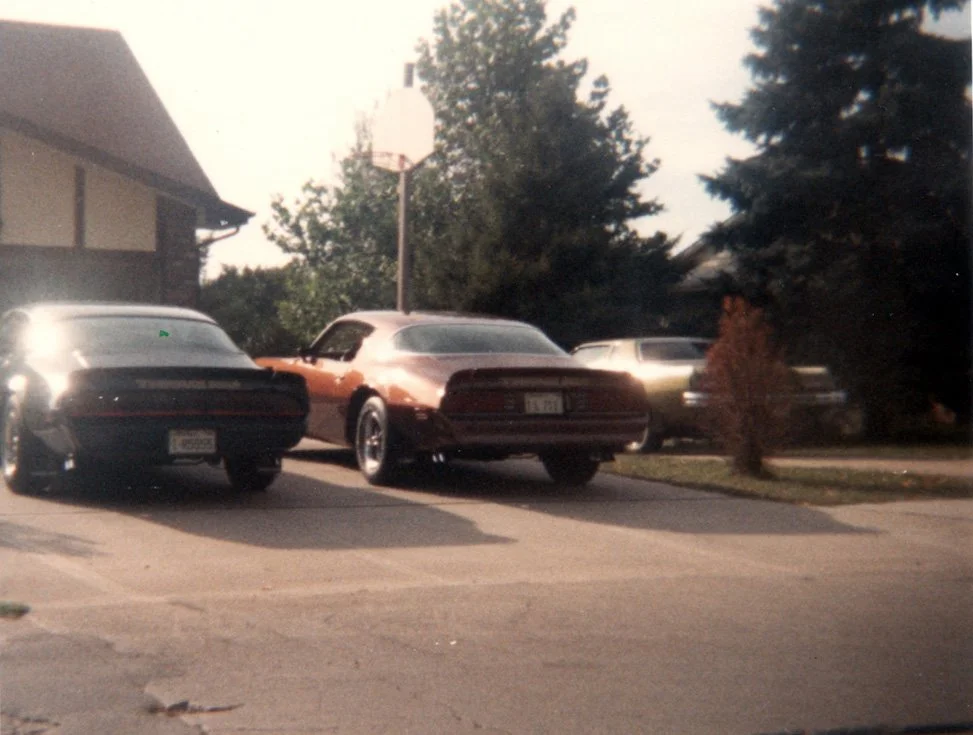
My dad snapped this series of photos in the mid-1980s shortly after purchasing the ‘79 Trans Am. What a time to grow up—three Pontiacs in our driveway!
The seller had the Trans Am’s original exhaust manifolds, catalytic converter, and y-pipe in a storage area near base. He told my dad that he could have them. “I didn’t want to place them in the trunk., so I told the seller I would try to come back and get them. Your sister, Gina was born a couple of days after I bought the car. Needless to say, I didn’t make it back before he was transferred. I wasn’t too concerned though. I figured I wouldn’t ever reinstall them anyway.”
My dad was thrilled with his ‘79 Trans Am. “It was like driving a new car,” he says. “I received so many complements. If I ordered the car, I wouldn’t have added the hood bird. I didn’t care for them then, but the gold bird looked really nice on that car. It jumped off the dark blue exterior. People would tell me they could see me coming a mile away—the glow of the bird made it stand out. I really came to appreciate the hood bird because of that car.”
In the years that followed, the Trans Am was never modified. “I opened the Shaker, but that was it. I had my ’78 Trans Am with the T/A 6.6 and 4-speed manual for fun,” he says. “After a couple, the Hooker headers (which were not ceramic coated) eventually rusted through. Because I never picked up the original exhaust manifolds, I had to purchase a pair from a local salvage yard. Johnny Butera (at Butera & Sons repair garage in Omaha) installed them. House of Mufflers bent a set of head pipes and connected them to the existing turbo mufflers. I was expecting some performance loss, but it felt no differently.”
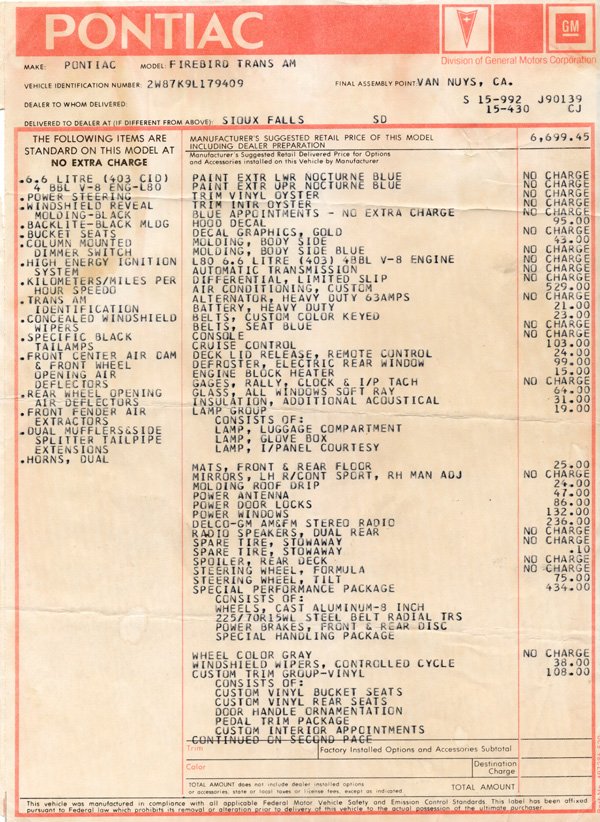
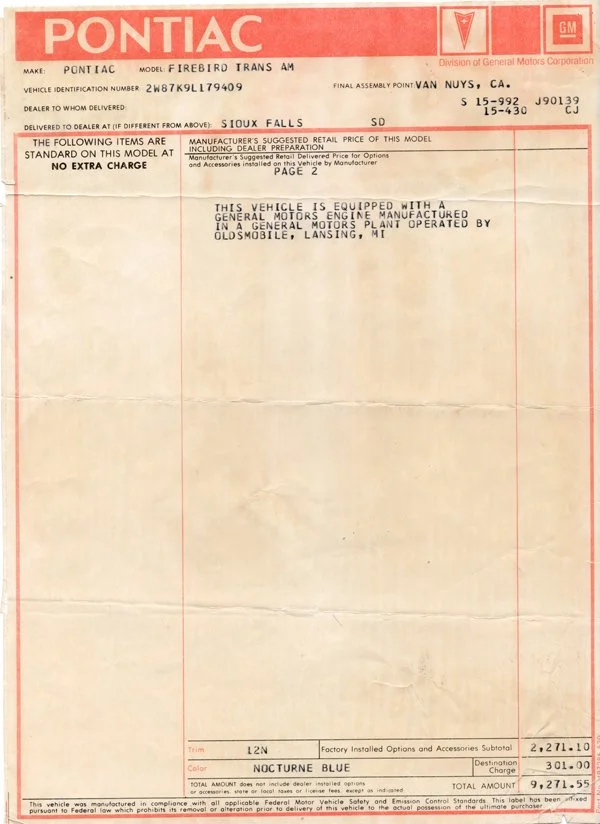
The Trans Am came with its original window sticker. It was equipped with so many convenience options that it carried over onto a second page. Note the delivery location notes “Sioux Falls, Sourh Dakota” only.
Eventually, the mufflers rusted out, too, and my dad had Bill Talbott at Mad Hatter Muffler and Brake in Omaha install a pair of turbo-style mufflers from a then-late model 5.0 Mustang. “The new mufflers had a great tone,” my dad says. “They were deeper than the originals and I really liked them.” I can attest to my dad’s sentiment. My grade school was having a field day at Hanscom Park in Omaha and my dad passed by unexpectedly. I remember hearing his car and turning to see him driving by!
The Trans Am never presented any major issues. The electric antenna was a new feature for 1979, and it would raise/lower whenever the radio was turned on/off. It would also raise/lower whenever the ignition was cycled on/off. My dad made daily sales calls, so it’s unsurprising to find that antenna’s electric motor eventually went out. “I had Johnny Butera replace the motor and install a toggle switch under the dash to control it manually.”
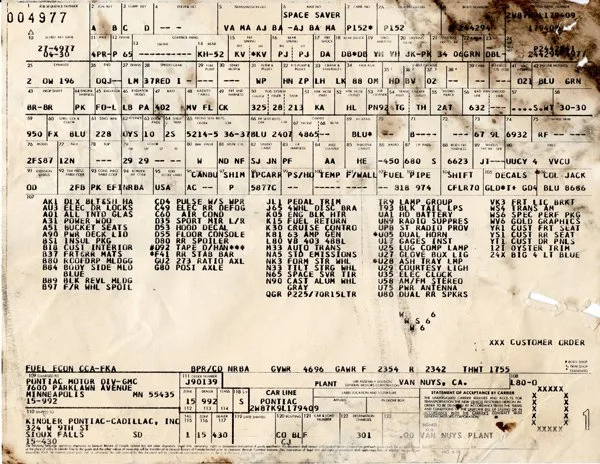
The Trans Am’s build sheet was located beneath the rear seat. It reveals that it was assembled at the Van Nuys, California plant on April 30, 1979. Note that it was billed to the Pontiac Motor Division and delivered through Kindler Pontiac in Sioux Falls. It was quite likely a company car used by the Minneapolis Zone rep.
Looking at the window sticker, the Trans Am was equipped with virtually every available option except t-tops or tape player. “I remember thinking, ‘Whoever ordered this car equipped it with everything possible including engine block heater.’ I figured that was because of the South Dakota winters. I never used it because the Trans Am was always garaged. One morning while driving to work, I hit the passing gear on the interstate entrance ramp to merge into traffic and saw a plume of white smoke behind me. I knew it was coolant but didn’t know from where. Fortunately, I coasted it a few blocks to Johnny Butera’s garage. He found that the block heater rusted through and replaced it with traditional core plug.”
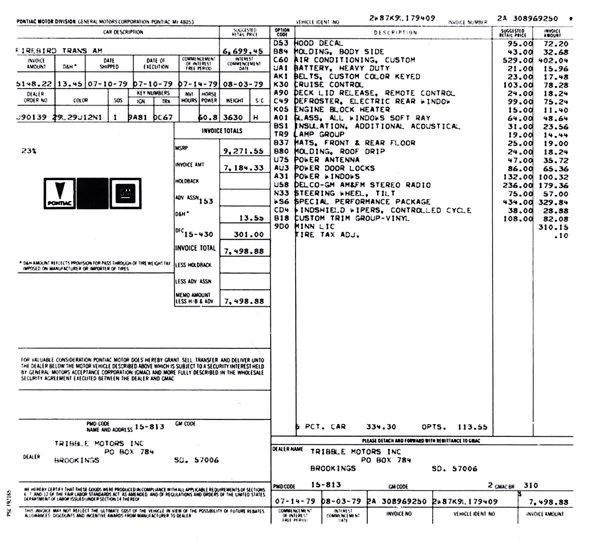
I recently ordered the Trans Am’s original dealer invoice from PHS Automotive Services. It reveals that the Pontiac invoiced the car to Trimble Motors in Brooking, South Dakota on July 14, 1979. Consistent with other Pontiac company cars I’ve documented, they’re loaded with convenience options. Employees typically used the vehicle for 3 months or 3,000 miles, whichever occurs first. The vehicle is then sold as a new car with full factory warranty at a 5 percent discount—as seen here.
I vividly recall of one unfortunate incident with the ’79 Trans Am at the Southroads Mall in Bellevue, Nebraska one sunny afternoon. My dad had just waxed the car and he parked it in a corner of the expansive parking lot, away from others. When we came back he found that someone had taken a key or nail and scratched the entire side of the car from fender to quarter panel. As you’d expect, my dad was very unhappy. Friend and coworker Mike Buzzello suggested that Ken Lane and Mike Cole at Tom’s Auto Body in Council Bluffs, Iowa perform the necessary repairs. “They matched the paint perfectly. You couldn’t ever tell that portions of the car had been repainted,” my dad adds.
Another incident I recall happened in our driveway. My dad always parked the ’79 Trans Am in the garage, but my mother had a garage sale one weekend, so my dad left in the driveway that night. “I was leaving for work on a Saturday morning and walked out to find that someone knocked out the driver’s side window and back glass. There were pieces of glass all over the interior. I took it to the glass shop to have them replaced and the guys pulled the rear seats bottoms to vacuum everything. When I went to pick up the car, they handed me the original build sheet and asked if I wanted it.”
By the early 1990s, the Trans Am had amassed more than 100,000 miles on its odometer. While still in excellent condition overall, my dad had the chance to acquire a low-mile ’86 Buick Regal T-type, which was a more practical family car than the aging F-car. Friend and coworker Bob Scarpino purchased the Trans Am in spring 1991 and drove it for a couple of years, before he, too, sold to another coworker. That person drove the Trans Am very hard and didn’t care for it the way that my dad or Bob Scarpino had. Then, one night he went off road at high speed, which damaged the Trans Am significantly. We’re unsure whatever became of the car after that.
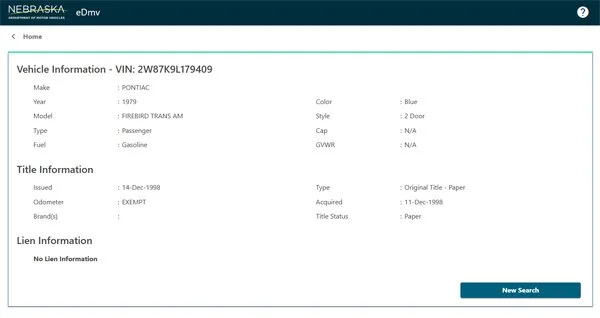
The Nebraska DMV website reveals that the ‘79 Trans Am was last sold on December 11, 1998 and titled on December 14. It doesn’t, however, disclose any owner info. There’s no telling it the car has been junked or is still around.
Looking back, of the ’79 Trans Am my dad says, “Nocturne Blue wasn’t as deep as Admiralty Blue, but it was just as beautiful of a color. The car looked incredible with gold decals and gray Snowflake wheels. I thought the oyster and light blue interior really complemented it well. The wheel flares were smaller and tighter, which freshened the look of the car for 1979, and they were soft and flexible, which made them hold up better for daily driving. I would put sandbags in the trunk and install snow tires for the winter and can’t recall ever having an issue getting around in the snow. I really loved driving that car.”
I decided to review the ’79 Trans Am’s window sticker. I found it lists “Sioux Falls, SD” as the delivering location, but no dealership was noted. The original build sheet revealed that the car was assembled April 30, 1979, billed to Pontiac Motor Division in Minneapolis, Minnesota, and delivered to the Division via Kindler Pontiac in Sioux Falls, South Dakota. It was then I suspected that my dad’s ’79 Trans Am was originally ordered by Pontiac’s Minneapolis Zone rep for use as a company car. The factory-to-dealer invoice confirmed my suspicion. The car was invoiced to Tribble Motors in Brookings, South Dakota on July 14, 1979, and included a 5 percent discount.
Now, some 35 years after I last rode in that ’79 Trans Am do I learn that that car that introduced me to WS6 was originally delivered to Pontiac Motor Division for factory use. As if that car wasn’t already memorable enough, it now has reason to be even more special to me!
Have you ever owned a Pontiac that was a factory car? Share your comments below